What this app is not
Eleven field tests at ten stations, re-tested every quarter, each read against a published table, stated reference lines or your own trend. Here is what it will not do, and what each test cannot say. The app carries the same page.
- No biological age
- No fitness age, no “years left”. Each test is read on its own against its own table. The one summary on the home screen, Standing, is the median of the percentiles from clinical tables, and it says so.
- No diagnosis
- Screening, not diagnosis. A low score is a reason to talk to a clinician, never a verdict. The mortality studies behind these tests are associations in groups, not predictions for one person.
- No AI
- No camera, no pose tracking, no coach that writes to you. You time and count; the app compares.
- No leaderboard
- No other users, no ranking, no streaks, no badges. The only comparisons are with published tables and with your own line.
- No account, no server
- Everything stays on your phone and in your own backup file. There is nothing to sign in to, and the app has no analytics.
- At most three notifications a quarter
- Two weeks before a re-test, a question: where and when will you do it. The day before, the time. And one if the two-week window closes with tests unfinished. Nothing in between.
What each test cannot say
- Grip
- Tells you about grip. The link to mortality runs through what grip stands in for, whole-body strength, and devices differ by several kilograms.
- Sit-and-rise
- A mix of strength, balance and flexibility. A bad knee or hip lowers the score without saying anything about your heart.
- One-leg balance
- One number from a screened volunteer sample. Below 60 the eyes-open stand hits its 45-second cap, so there is no percentile there.
- VO₂max from a watch
- An estimate that can be off by about 10 mL/kg/min for one person. Treat it as a trend, not a measurement.
- Push-ups
- Read from five published categories, which the app treats as fifths of the population. That is the app’s assumption, so the result is labelled estimated.
- Dead hang
- No population table exists. The lines are one coach’s stated opinion, named on every result, and there is no percentile.
- Farmer carry
- No table and no outcome study exist, so there is no percentile and no line. The time is a trend against your own history at the same load.
- The stair test
- Read against one clinical sample of 165 patients. The two lines are the app’s reading of that study, not a norm.
Each test page lists the full limits of its reference, and the source with its year, sample size and who was sampled.
Who should skip a test
The floor sit-and-rise. Skip it with a recent knee, hip or back injury, a joint replacement, or if getting down to the floor is already hard.
The field VO₂max tests and the stair climb. They are maximal efforts. Skip them if a doctor has told you to avoid hard exercise.
The one-leg stands. A wall within reach, always. Never alone the first time if you are over 65.
Any test you skip simply has no result. The rest still count.
A safer alternative: the 30-second chair stand
Stand up from a chair and sit back down as many times as you can in 30 seconds, arms crossed. It is the fall-risk screen clinicians use from 60, and the CDC’s STEADI materials give the below-average counts by age and sex. The app does not score it yet; the CDC sheet does.
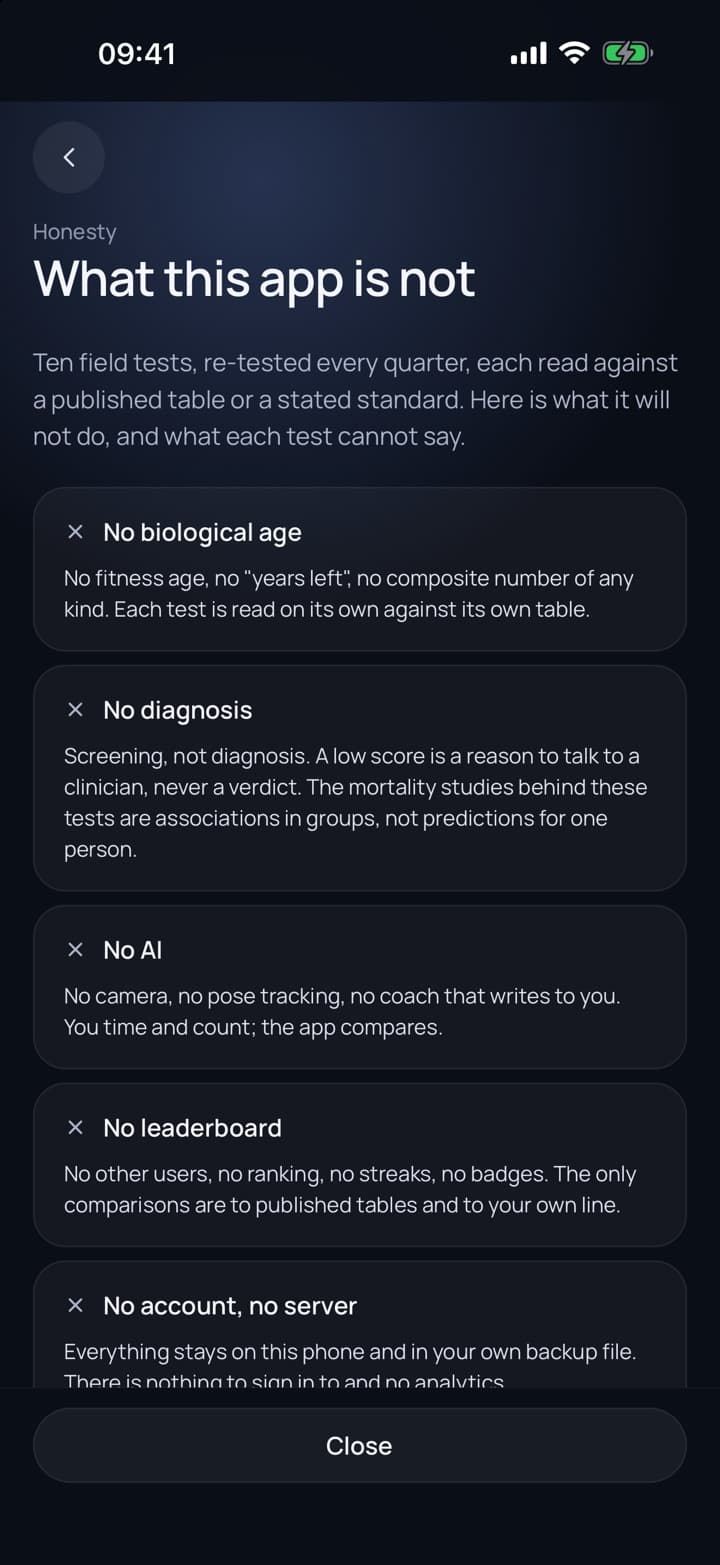
The same page, in the app.
Longstanding compares you with published norms. It is not medical advice and does not diagnose anything.